
Our vision
The Green House first formed in September 2014 as a home education group and in 2016 it became a Community Interest Company (CIC). Since 2018 it has been growing into a thriving self-directed learning community.
Our core question that inspires us and that we strive to explore is:
How do we create a learning community where children are supported to:
Our core question that inspires us and that we strive to explore is:
How do we create a learning community where children are supported to:
- know and be themselves,
- relate to others and the world,
- discover, express and explore their passions?
We have a range of indoor and outdoor spaces equipped with learning materials. Young people range in age from 5-16 and we have three inspiring and experienced facilitators. Facilitators provide assistance and guidance to enable the young people to explore their interests and passions.
The facilitators help to hold a safe and nurturing environment through their care and emotional support. This fosters positive relationships and honest communication throughout the community.
Relationships, emotional literacy and understanding are of key importance in our learning community. We use non violent communication and model a wide variety of language that expresses all the emotions that humans can feel. We help young people get to know and give voice and expression to their emotions and hold the belief that feeling is the entrance point to knowing, discovering and expressing our needs.
The members of our community listen and acknowledge each other's feelings, this can look like knowing how people are at the start of the day through to acknowledging feelings within a conflict or challenge. Once people feel heard then a plan to transform the conflict can happen. In a conflict situation we acknowledge that all those involved are hurting. We support the most vulnerable first and we work with young people to get back into a place of regulation by having regulated adult support to come alongside the young person. This adult support can look like having a facilitator actively listening and occasionally it can mean that a parent is asked to come in to support their child. What we don’t do is use punishment for behaviour that comes from dysregulation, what we do do is acknowledge that in times of dysregulation the young person needs extra support and we work with parents to put that support in place.
The facilitators help to hold a safe and nurturing environment through their care and emotional support. This fosters positive relationships and honest communication throughout the community.
Relationships, emotional literacy and understanding are of key importance in our learning community. We use non violent communication and model a wide variety of language that expresses all the emotions that humans can feel. We help young people get to know and give voice and expression to their emotions and hold the belief that feeling is the entrance point to knowing, discovering and expressing our needs.
The members of our community listen and acknowledge each other's feelings, this can look like knowing how people are at the start of the day through to acknowledging feelings within a conflict or challenge. Once people feel heard then a plan to transform the conflict can happen. In a conflict situation we acknowledge that all those involved are hurting. We support the most vulnerable first and we work with young people to get back into a place of regulation by having regulated adult support to come alongside the young person. This adult support can look like having a facilitator actively listening and occasionally it can mean that a parent is asked to come in to support their child. What we don’t do is use punishment for behaviour that comes from dysregulation, what we do do is acknowledge that in times of dysregulation the young person needs extra support and we work with parents to put that support in place.
I like that you learn, but you don't notice you're learning. Like, now I know all about tungsten. - Rowan, child at Greenhouse
Dates for interested parents evenings
|
We hold regular interested parents evenings online. For dates of the next interested parents evening, please contact us . You can also see updates through our Facebook page.
We are based at Meadows livery in Bitton, South Gloucestershire. Our beautiful rural site has plenty of open space to play and includes access to woods and a stream. We have a dome, two large static caravans and a converted stable block for our use. |
Fees
- £40.43 per day, £121.28 per week, £1455.30 per 12 week term
- We invoice for fees at the start of each term
- A discount of 10% is available for siblings
- Some younger children may start integrating into the project by attending 2 days per week working up to doing three days. If this is needed then the fees are slightly higher per day £46.20 per day, £92.40 per week, £1108.80 per 12 week term.
- If you'd like to have a flexible payment plan, we're open to discussion and finding a solution for this.
Joining fees
We ask for a contribution of £40 per meeting towards staffing our alignment meetings with parents (usually only one meeting is needed). If you decide to take up a place at the Green House, we require a term's worth of refundable deposit paid in two stages. The deposit is to ensure that the 12 week term time notice period is honoured which protects the payment of the staff wages and gives us time to enrol a new child to take up the vacancy. The deposit is returned if all fees have been paid when your child leaves the Green House.
Financial assistance
To support affordability, the Green House is currently applying to become a childcare provider registered with Ofsted. This will allow families on Universal Credit and people who use tax free childcare or childcare vouchers to claim money back. Please note, there are no curriculum requirements with child care registration.
Term dates
Similar to mainstream schools, our year is split into six terms or ‘chunks’. Each chunk is 6 weeks long. Our holidays are slightly longer than mainstream settings and partially overlap so that some of the holidays align with mainstream schools, allowing connection with our schooled friends and relatives and some don’t so that our home educated families can take advantage of affordable holidays and less busy holiday activities. See this year’s dates.
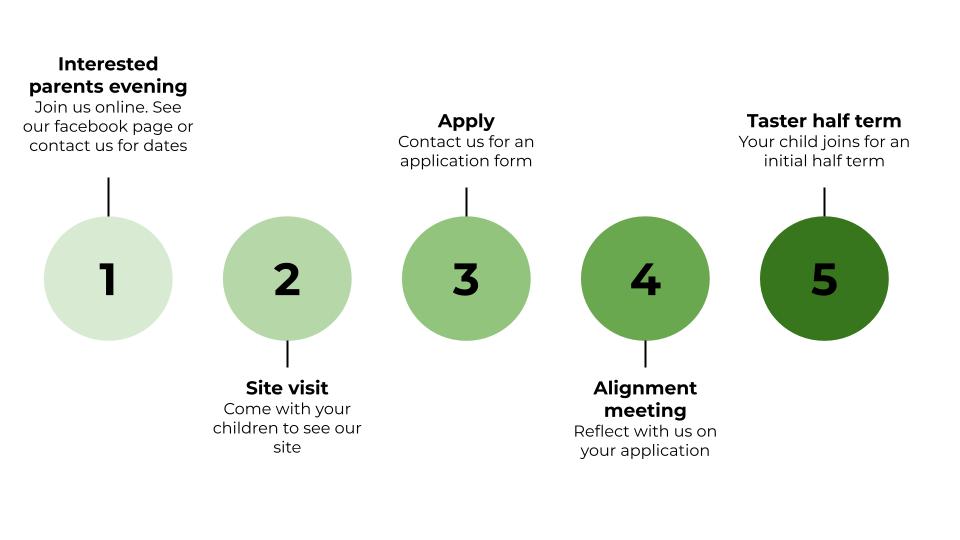
Our joining process
Agreements
We ask all young people and families to sign up to our agreements when they start their time with us. You can read through the agreements here and ask questions about them at the alignment meeting.
We ask all young people and families to sign up to our agreements when they start their time with us. You can read through the agreements here and ask questions about them at the alignment meeting.

|
| ||||
Questions you might have
Can my child attend just one or two days per week?
We recognise that our youngest children, or children new to the community may need to attend less than three days per week at first. If this is thought to be a need this can be discussed at your alignment meeting. If it is agreed as a beneficial way to integrate into the project it will be with the view to building towards attending the full three. The reason we choose to have all children attend 3 days per week is so that we have consistency of attendance which enables a strong culture within the community supporting strong relationships, group projects and a focused and undisrupted flow to the 3 days.
Do children enjoy being at the Green House?Yes! The Green House is consent-based education. Young people are only with us if they want to be. Most of the time parents struggle to get their children to go home and young people are sad that we have half term and holidays. At the same time, like with everything, there are days when being at the Green House is difficult and young people would rather be at home or somewhere else. At the Green House we welcome all feelings and support young people to be with and accept what they feel. We have no expectation that young people always enjoy the Green House.
Do you have rules at the Green House and how do you apply them?
Boundaries are essential at the Green House. They keep us all safe.
We use agreements rather than rules. Young people consenting to be here is really important to us. So, before joining we share the agreements that we ask children and adults to agree to as part of being in our learning community (link to young people agreements)
All the other agreements that help our community to flow smoothly and easily are co-created with the young people, like how we make our meetings more fun and enjoyable. This means we have a feeling of ownership for the community we are a part of.
We do not use punishment at the Green House. We see all behaviour as a message. And we are committed to creating a safe and free space for us all to be in. If a behaviour is dangerous that is stopped immediately, and support given to restore the regulation of all the people involved. We know the young people really well and work in collaboration with parents to support young people to keep agreements, this takes various forms and is done with utmost care and consideration for all involved.
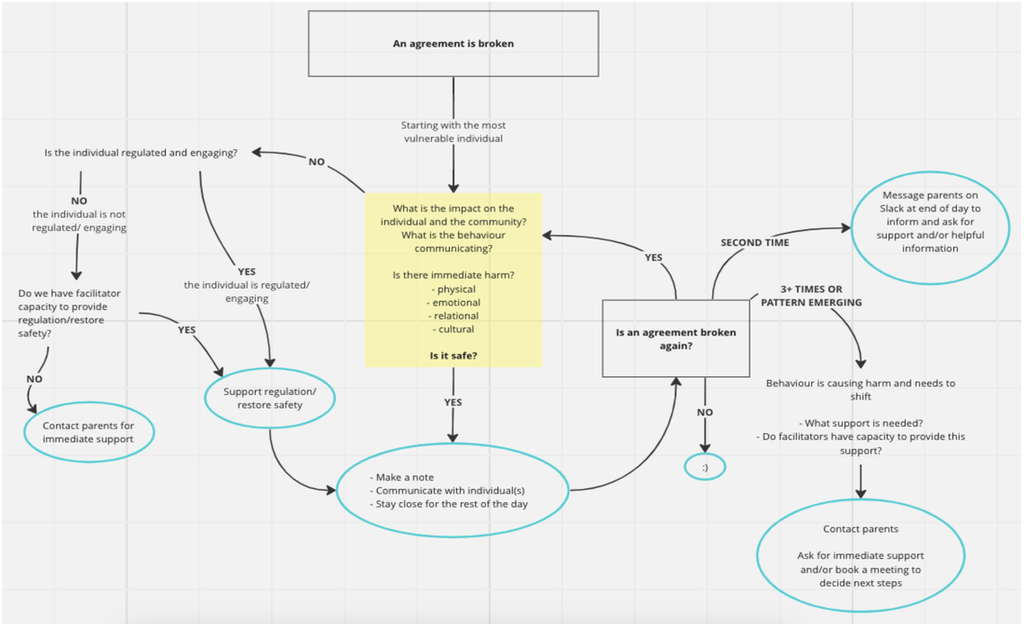
This is a process (see flow diagram below) that we created as a team to support us all to keep the Green House agreements and ensure that it is a safe and free space. We are all unlearning in this process, and we are consistently looking at better ways to do this.
We recognise that our youngest children, or children new to the community may need to attend less than three days per week at first. If this is thought to be a need this can be discussed at your alignment meeting. If it is agreed as a beneficial way to integrate into the project it will be with the view to building towards attending the full three. The reason we choose to have all children attend 3 days per week is so that we have consistency of attendance which enables a strong culture within the community supporting strong relationships, group projects and a focused and undisrupted flow to the 3 days.
Do children enjoy being at the Green House?Yes! The Green House is consent-based education. Young people are only with us if they want to be. Most of the time parents struggle to get their children to go home and young people are sad that we have half term and holidays. At the same time, like with everything, there are days when being at the Green House is difficult and young people would rather be at home or somewhere else. At the Green House we welcome all feelings and support young people to be with and accept what they feel. We have no expectation that young people always enjoy the Green House.
Do you have rules at the Green House and how do you apply them?
Boundaries are essential at the Green House. They keep us all safe.
We use agreements rather than rules. Young people consenting to be here is really important to us. So, before joining we share the agreements that we ask children and adults to agree to as part of being in our learning community (link to young people agreements)
All the other agreements that help our community to flow smoothly and easily are co-created with the young people, like how we make our meetings more fun and enjoyable. This means we have a feeling of ownership for the community we are a part of.
We do not use punishment at the Green House. We see all behaviour as a message. And we are committed to creating a safe and free space for us all to be in. If a behaviour is dangerous that is stopped immediately, and support given to restore the regulation of all the people involved. We know the young people really well and work in collaboration with parents to support young people to keep agreements, this takes various forms and is done with utmost care and consideration for all involved.
This is a process (see flow diagram below) that we created as a team to support us all to keep the Green House agreements and ensure that it is a safe and free space. We are all unlearning in this process, and we are consistently looking at better ways to do this.
What do young people do while they are with you?
There is no typical day the Green House! Each day is different and flavoured with what is on offer, as well as what arises in response to the day unfolding. It is really difficult to describe extensively what young people do while they are here.
We do have a structure for the day: it starts with morning meeting and ends with tidy up time. In between those two things there are a plethora of offerings and activities for young people to enjoy and engage in.
We call the activities at the Green House offerings,and they are run by adults or children alike. These can be anything from Cat Club to D & D, preparing for celebrations and festivals, sport with Hannah etc.
A day for a young person may look like coming to morning meeting, hanging out with friends while crafting in the making space, attending an offering about current affairs while drinking a cup of tea, making a den in our small woods, spending half an hour mine craft gaming with your friends, being captured in cops and robbers, joining in a game of werewolf, creating a board game with some other young people, and then tidying up the space together while listening to your favourite band. Phew! Alternatively you could just immerse yourself in the making space designing and making a softie. It depends on what you are in to, where your energy levels are at, and is also impacted if it's a wet winter’s morning or a hot summer afternoon.
Do you have any different offerings for older children?
This is an area that we are currently growing in and giving extra focus to.
What we have found is that with self directed learning when young people get into double digits what they are looking for in our setting changes. It seems that they are looking for some support in planning, carrying out and completing individual and group projects. Enter what we call GPS (Green House/Group Project Support).
In GPS young people gather a few times a week to share their project plans, gain ideas from each other and plan in slots with facilitators to support them with their current projects. We use various tools for this including Kanban boards, Trello and peer feedback to support the young people in making their ideas a reality. We also collaborate with parents to support the young people with their projects.
Project examples are designing a roleplay game, running a football match, learning guitar, making a Green House “Guess who?”, accumulating 10 000 pins of you latest celebrity crush, organising and running a winter fayre, exploring the possibility of getting a Green House digger and casting some D & D dice.
There are a variety of other ways that we support older children, which are tailored to the unique young people that attend the Green House. We would love to have a few more older children to join our Green House crew.
How much parent involvement is expected?
Parents are an essential part of our community and we work closely together to co-create our learning community. We value regular communication between parents, both in person and through our Slack channels. This is a key part of supporting young people to thrive. We find that our relationship with parents is the foundation on which the children can blossom at the Green House.
Facilitators have regular check-ins with parents, both informal conversations at the beginning and end of the Green House day, as well as in scheduled meetings. Our parent agreement document (insert link) has more info about what we ask of in terms of parent contributions.
Some of the main ways parents are involved are:
How do you keep your young people safe?
Safety is at the core of what we do. We recognise that we can only learn and thrive when we feel safe.
There are lots of ways we ensure safety, the main one being building nurturing and connected relationships with the young people. This means we get to know when they are needing support or may feel dysregulated. Some of the other ways we ensure safety is through:
Do you have young people with special educational needs? Or neurodiversity?
At the Green House we value and celebrate diversity. We believe that we all have diverse needs. And that neuro-spiciness (neurodiversity) is a spectrum that we all fall somewhere on. Therefore there are a number of diverse young people and adults at the Green House.
At the same time we are mindful of the dance between individual needs and our communities capacity to support the individual. We have an extensive and thorough enrollment process, which looks at our capacity to meet the individual young person’s needs. It is important to us that young people are well supported and that we do not do this at the expense of the rest of the community.
What we often find is that many young people who have struggled in other educational settings thrive at the Green House. A Green House parent, who's neuro-spicy child previously attended school, shared with us that she has noticed that young people don't mask their behaviours at the Green House. Which was lovely to hear. We think this is due to a number of factors, one of the main ones being our focus on getting to know each child as the unique and amazing human being that they are. As well as our focus on relationships and fostering a sense of belonging. We believe that if young people feel safe, free and connected there is very little that will limit their ability to thrive.
We also work closely with a variety of professionals when needed to support the young people.
In her book ‘A Different Way to Learn: Neurodiversity and Self-Directed Education” ’ Psychologist Dr Naomi Fisher explains: “Neurodivergent children experience and interact with the world differently to many of their peers. Standard educational systems often fail to adapt to their unique strengths and ways of learning. School, and even the act of learning, can become a source of great anxiety and trauma. Self-directed education offers an alternative to traditional schools that can help neurodivergent children develop at their own pace and thrive.”
Do you have a diverse culture at the Green House?
"Exclusion is derived from fear, ignorance, and power, whilst inclusion is derived from love, compassion, and respect." Michelle Emson
We asked the young people recently what our Green House culture was made of and it was really lovely that “pride friendly,” “all people accepted,” “everyone’s voice is heard” and other inclusive phrases were shared.
Our motto is “free to be.” We spend a lot of time and energy as a team looking at how we can create a community where diversity is celebrated, valued and honoured. We recognise diversity is both internal and external. It's both about accepting different celebrations and cultural practices, as well as about the different ways that we as humans express ourselves.
We are in a constant dance at the Green House of how to foster a feeling of belonging, as well as how to create space for a diversity of expressions. This is a continuous learning process for us. And we value learning from other communities and organisations in this.
One of our grown edges at the moment is making power dynamics visible and how we address this in our community. We also are learning about our biases and what it means to cater for individual needs while being part of a shared community.
Have any of your young people ever gone to school?
Yes. There are also young people who have always been homeschooled too.
We find that children who have previously been to school take time to decompress from school and get used to the different way our learning community runs.
Sometimes we recommend that families coming from school take time to deschool before they join us. As it can be quite a big change to come from school into the Green House. However, since COVID (where schooling was done from home) we have found families already have some experience of a type of home education.
We use the alignment meeting in our enrollment process to discuss your individual family’s context and needs.
What about learning to read and write and times tables?
We all have an innate desire to learn. This is core to our Green House self directed approach. When young people feel safe and a sense of belonging we find that they are curious about the world around them and largely generate their own learning. In a sponge like fashion they absorb all that they can from what is around them. In this way learning is meaningful, relevant and fun!
We see young people writing ransom notes in a fantasy game, reading the instructions to games they want to play, working how to evenly share out a cake they baked with the whole community, writing lyrics to a song they are composing with Dean (our regular musical expert) and many, many other ways that they enthusiastically and independently engage with the world around them.
At the Green House learning happens all the time, visibly and invisibly. As young people drive their own learning, they build on their existing neural pathways, which both broadens and deepens their learning.
And sometimes young people request offerings focused on writing, reading and numeracy. Facilitators respond to this with activities, resources and ideas to support them to pursue this interest, in the same way they do with any other interest.
In this way learning makes sense and is owned by the young person. This often means they learn at a pace and depth that far exceeds some of the rote and dissected learning that is available in other educational settings.
It is magical and inspiring watching how intrinsically motivated and passionate young people are when they learn this way. It's beautiful to see what they are capable of. It also requires us as adults to unlearn a lot of our inherited beliefs and limits learned from our educational experiences. That is why it's valuable to be in a community with other parents who are sharing the journey, where we can encourage, support and (un)learn together.
Do young people have access to the internet and electronic devices?
At the Green House we are tech positive. We view technology as a tool, one of the many, that are available to young people.
We are aware that the internet and technology can raise a lot of different feelings and opinions in each of us and we approach technology in a similar way to everything else that we engage with on this self directed learning: with curiosity, openness, a commitment to unlearn and relearn and seeing both the challenges and the values.
Our approach to digital technology has been created in consultation with other self directed settings, as well as other professionals. It is once again an area that we are learning and growing in.
Young people have access to the internet at the Green House and we ask that they log on through the Green House wifi, which has fire walls and safety measures to maximise safe access to the internet. We have four Green House devices that young people can use at the Green House. Young people also bring their own devices to use at the Green House.
Every six weeks one of our culture committee meetings (a compulsory weekly meeting that young people agree to attend when they agree to join the Green House), we have a focus on digital technology and safety. Our young people have great awareness and skill in internet hygiene and are often sharing where they think that we need to give some attention or focus.
For us one of the roles of adults in our learning community is to support young people safely and easily navigating the use of digital technology. Learning from it and also having a critical approach to what is of value and what be of harm. For us engaging with the world is not about removing all risks and making sure that nothing bad ever happens, we know that is not possible. It is about supporting young people to navigate the challenges of the world (inclduding digital technology) with awareness, confidence and the skills to ask for help and support when needed.
When young people experience discomfort in any form for whatever reason we want them to know that they are not alone and that there are safe adults in their lives to process things with. We want them to discover what is okay and not okay for them and how to express their boundaries: to develop the skills of how to express their yes and their no with clarity, confidence and self awareness. This is something that we are committed to supporting young people with. And these are essential skills that are needed as navigate the uncertain, fast paced and ever changing world of digital technology.
Are children dropped off or do parents stay with the children?
Our learning community is comprised of young people and facilitators. Parents usually drop off their children for the Green House day.
In the taster term (6 weeks), sometimes parents stay with their children until they are settled and ready to attend the Green House on their own. This can take a few hours or a few weeks or more. For us young people feeling safe and connected at the Green House is essential and we know that young people need different things and varying amounts of time to support this happening.
Some days you may need your parent to stay with you and that is also fine with us. Sometimes parents stay and run activities (offerings) and/or join in on offerings that are happening in the community. We enjoy parents being a part of what we do and equally we know that some parents need to work too.
What has the Greenhouse been like for others?
"We joined the Greenhouse after two and a half years of my son being at mainstream school. We deliberated over the move for several months - although my son wasn’t happy at school, it was a known entity and we had friends there we’d be sad to leave.
Yet, two months later, we couldn’t have hoped for better - I’m so happy we took the risk and joined; after years of feeling uneasy with the path we were on at school, I truly believe he is in a place where he can be comfortable in being himself, reconnect with the joy of life and learning and be valued for who he is.
Relationships and communication are valued at the greenhouse; without the constraints of a curriculum and pre-defined outputs, facilitators are able to be fully present, enabling positive interactions, modelling healthy relationships and gently guiding creative, constructive play.I’m always impressed at the facilitators’ skilful way of stepping in when needed while at other times giving space for growth.
Conflicts and challenges are taken seriously and boundaries are swiftly set and held when needed. This creates and maintains a safe space where children can be themselves and are able to learn without fear of hurtful judgement. The creativity that sparks between the children is wonderful, ideas bounce between them and each day I’m amazed at what has been made or imagined; be it dens, pictures, models or stories.
In the short time that my son has been at the greenhouse, the changes in him have been a joy to see. Now he wants to get up and out in the morning and takes the lead in getting himself ready to go. He speaks up and engages with the meetings, sharing his feelings and needs and is more relaxed in his play with others. In his words “I love the Greenhouse!” - Mary, Parent
"The Green House has given Z the opportunity to explore his interests, form new friendships and do we he loves most - spending most of the day outside in nature. He has the freedom here to flourish into his full, unique self.The Green House is a supportive, nurturing environment that respects young people and in turn helps them learn how to respect and be in community with others.""When asked what his favourite thing about GH is, Z said "everything!" - Lauren, Parent
"It feels like home. I know my daughter is safe, held, loved and seen by the faciliatators, the other children and the community as a whole. She is free to be and express herself and explore her passions with support where she needs. A beautiful project, completely inspiring and heart led. So grateful we’ve landed here!" - Chez, parent
"My son recently started at the greenhouse and it has been a revelation for us. The most thoughtful, creative, welcoming and nurturing community of amazing kids and their families. The facilitators are so supportive and inspiring. My kid is finally happy" - Zoe, parent
There is no typical day the Green House! Each day is different and flavoured with what is on offer, as well as what arises in response to the day unfolding. It is really difficult to describe extensively what young people do while they are here.
We do have a structure for the day: it starts with morning meeting and ends with tidy up time. In between those two things there are a plethora of offerings and activities for young people to enjoy and engage in.
We call the activities at the Green House offerings,and they are run by adults or children alike. These can be anything from Cat Club to D & D, preparing for celebrations and festivals, sport with Hannah etc.
A day for a young person may look like coming to morning meeting, hanging out with friends while crafting in the making space, attending an offering about current affairs while drinking a cup of tea, making a den in our small woods, spending half an hour mine craft gaming with your friends, being captured in cops and robbers, joining in a game of werewolf, creating a board game with some other young people, and then tidying up the space together while listening to your favourite band. Phew! Alternatively you could just immerse yourself in the making space designing and making a softie. It depends on what you are in to, where your energy levels are at, and is also impacted if it's a wet winter’s morning or a hot summer afternoon.
Do you have any different offerings for older children?
This is an area that we are currently growing in and giving extra focus to.
What we have found is that with self directed learning when young people get into double digits what they are looking for in our setting changes. It seems that they are looking for some support in planning, carrying out and completing individual and group projects. Enter what we call GPS (Green House/Group Project Support).
In GPS young people gather a few times a week to share their project plans, gain ideas from each other and plan in slots with facilitators to support them with their current projects. We use various tools for this including Kanban boards, Trello and peer feedback to support the young people in making their ideas a reality. We also collaborate with parents to support the young people with their projects.
Project examples are designing a roleplay game, running a football match, learning guitar, making a Green House “Guess who?”, accumulating 10 000 pins of you latest celebrity crush, organising and running a winter fayre, exploring the possibility of getting a Green House digger and casting some D & D dice.
There are a variety of other ways that we support older children, which are tailored to the unique young people that attend the Green House. We would love to have a few more older children to join our Green House crew.
How much parent involvement is expected?
Parents are an essential part of our community and we work closely together to co-create our learning community. We value regular communication between parents, both in person and through our Slack channels. This is a key part of supporting young people to thrive. We find that our relationship with parents is the foundation on which the children can blossom at the Green House.
Facilitators have regular check-ins with parents, both informal conversations at the beginning and end of the Green House day, as well as in scheduled meetings. Our parent agreement document (insert link) has more info about what we ask of in terms of parent contributions.
Some of the main ways parents are involved are:
- Half termly community meeting
- Site days: maintaining, repairing and improving our site).
- Doing an offering (running an activity for young people)
- Fundraising
- Supporting with community events
- Maintaining our website etc.
- Helping to find resources that we need (both people and things)
How do you keep your young people safe?
Safety is at the core of what we do. We recognise that we can only learn and thrive when we feel safe.
There are lots of ways we ensure safety, the main one being building nurturing and connected relationships with the young people. This means we get to know when they are needing support or may feel dysregulated. Some of the other ways we ensure safety is through:
- our young people's agreement (view here)
- Parent/caregivers agreements (view here)
- our weekly culture committee, where we discuss how we continue to create a safe and fun community culture
- Safeguarding and health and safety policies and checks
- DBS checks for all adults on site
- Fire drills etc
- First aid and safeguarding training for facilitators
- Our regulation support (insert link) .
Do you have young people with special educational needs? Or neurodiversity?
At the Green House we value and celebrate diversity. We believe that we all have diverse needs. And that neuro-spiciness (neurodiversity) is a spectrum that we all fall somewhere on. Therefore there are a number of diverse young people and adults at the Green House.
At the same time we are mindful of the dance between individual needs and our communities capacity to support the individual. We have an extensive and thorough enrollment process, which looks at our capacity to meet the individual young person’s needs. It is important to us that young people are well supported and that we do not do this at the expense of the rest of the community.
What we often find is that many young people who have struggled in other educational settings thrive at the Green House. A Green House parent, who's neuro-spicy child previously attended school, shared with us that she has noticed that young people don't mask their behaviours at the Green House. Which was lovely to hear. We think this is due to a number of factors, one of the main ones being our focus on getting to know each child as the unique and amazing human being that they are. As well as our focus on relationships and fostering a sense of belonging. We believe that if young people feel safe, free and connected there is very little that will limit their ability to thrive.
We also work closely with a variety of professionals when needed to support the young people.
In her book ‘A Different Way to Learn: Neurodiversity and Self-Directed Education” ’ Psychologist Dr Naomi Fisher explains: “Neurodivergent children experience and interact with the world differently to many of their peers. Standard educational systems often fail to adapt to their unique strengths and ways of learning. School, and even the act of learning, can become a source of great anxiety and trauma. Self-directed education offers an alternative to traditional schools that can help neurodivergent children develop at their own pace and thrive.”
Do you have a diverse culture at the Green House?
"Exclusion is derived from fear, ignorance, and power, whilst inclusion is derived from love, compassion, and respect." Michelle Emson
We asked the young people recently what our Green House culture was made of and it was really lovely that “pride friendly,” “all people accepted,” “everyone’s voice is heard” and other inclusive phrases were shared.
Our motto is “free to be.” We spend a lot of time and energy as a team looking at how we can create a community where diversity is celebrated, valued and honoured. We recognise diversity is both internal and external. It's both about accepting different celebrations and cultural practices, as well as about the different ways that we as humans express ourselves.
We are in a constant dance at the Green House of how to foster a feeling of belonging, as well as how to create space for a diversity of expressions. This is a continuous learning process for us. And we value learning from other communities and organisations in this.
One of our grown edges at the moment is making power dynamics visible and how we address this in our community. We also are learning about our biases and what it means to cater for individual needs while being part of a shared community.
Have any of your young people ever gone to school?
Yes. There are also young people who have always been homeschooled too.
We find that children who have previously been to school take time to decompress from school and get used to the different way our learning community runs.
Sometimes we recommend that families coming from school take time to deschool before they join us. As it can be quite a big change to come from school into the Green House. However, since COVID (where schooling was done from home) we have found families already have some experience of a type of home education.
We use the alignment meeting in our enrollment process to discuss your individual family’s context and needs.
What about learning to read and write and times tables?
We all have an innate desire to learn. This is core to our Green House self directed approach. When young people feel safe and a sense of belonging we find that they are curious about the world around them and largely generate their own learning. In a sponge like fashion they absorb all that they can from what is around them. In this way learning is meaningful, relevant and fun!
We see young people writing ransom notes in a fantasy game, reading the instructions to games they want to play, working how to evenly share out a cake they baked with the whole community, writing lyrics to a song they are composing with Dean (our regular musical expert) and many, many other ways that they enthusiastically and independently engage with the world around them.
At the Green House learning happens all the time, visibly and invisibly. As young people drive their own learning, they build on their existing neural pathways, which both broadens and deepens their learning.
And sometimes young people request offerings focused on writing, reading and numeracy. Facilitators respond to this with activities, resources and ideas to support them to pursue this interest, in the same way they do with any other interest.
In this way learning makes sense and is owned by the young person. This often means they learn at a pace and depth that far exceeds some of the rote and dissected learning that is available in other educational settings.
It is magical and inspiring watching how intrinsically motivated and passionate young people are when they learn this way. It's beautiful to see what they are capable of. It also requires us as adults to unlearn a lot of our inherited beliefs and limits learned from our educational experiences. That is why it's valuable to be in a community with other parents who are sharing the journey, where we can encourage, support and (un)learn together.
Do young people have access to the internet and electronic devices?
At the Green House we are tech positive. We view technology as a tool, one of the many, that are available to young people.
We are aware that the internet and technology can raise a lot of different feelings and opinions in each of us and we approach technology in a similar way to everything else that we engage with on this self directed learning: with curiosity, openness, a commitment to unlearn and relearn and seeing both the challenges and the values.
Our approach to digital technology has been created in consultation with other self directed settings, as well as other professionals. It is once again an area that we are learning and growing in.
Young people have access to the internet at the Green House and we ask that they log on through the Green House wifi, which has fire walls and safety measures to maximise safe access to the internet. We have four Green House devices that young people can use at the Green House. Young people also bring their own devices to use at the Green House.
Every six weeks one of our culture committee meetings (a compulsory weekly meeting that young people agree to attend when they agree to join the Green House), we have a focus on digital technology and safety. Our young people have great awareness and skill in internet hygiene and are often sharing where they think that we need to give some attention or focus.
For us one of the roles of adults in our learning community is to support young people safely and easily navigating the use of digital technology. Learning from it and also having a critical approach to what is of value and what be of harm. For us engaging with the world is not about removing all risks and making sure that nothing bad ever happens, we know that is not possible. It is about supporting young people to navigate the challenges of the world (inclduding digital technology) with awareness, confidence and the skills to ask for help and support when needed.
When young people experience discomfort in any form for whatever reason we want them to know that they are not alone and that there are safe adults in their lives to process things with. We want them to discover what is okay and not okay for them and how to express their boundaries: to develop the skills of how to express their yes and their no with clarity, confidence and self awareness. This is something that we are committed to supporting young people with. And these are essential skills that are needed as navigate the uncertain, fast paced and ever changing world of digital technology.
Are children dropped off or do parents stay with the children?
Our learning community is comprised of young people and facilitators. Parents usually drop off their children for the Green House day.
In the taster term (6 weeks), sometimes parents stay with their children until they are settled and ready to attend the Green House on their own. This can take a few hours or a few weeks or more. For us young people feeling safe and connected at the Green House is essential and we know that young people need different things and varying amounts of time to support this happening.
Some days you may need your parent to stay with you and that is also fine with us. Sometimes parents stay and run activities (offerings) and/or join in on offerings that are happening in the community. We enjoy parents being a part of what we do and equally we know that some parents need to work too.
What has the Greenhouse been like for others?
"We joined the Greenhouse after two and a half years of my son being at mainstream school. We deliberated over the move for several months - although my son wasn’t happy at school, it was a known entity and we had friends there we’d be sad to leave.
Yet, two months later, we couldn’t have hoped for better - I’m so happy we took the risk and joined; after years of feeling uneasy with the path we were on at school, I truly believe he is in a place where he can be comfortable in being himself, reconnect with the joy of life and learning and be valued for who he is.
Relationships and communication are valued at the greenhouse; without the constraints of a curriculum and pre-defined outputs, facilitators are able to be fully present, enabling positive interactions, modelling healthy relationships and gently guiding creative, constructive play.I’m always impressed at the facilitators’ skilful way of stepping in when needed while at other times giving space for growth.
Conflicts and challenges are taken seriously and boundaries are swiftly set and held when needed. This creates and maintains a safe space where children can be themselves and are able to learn without fear of hurtful judgement. The creativity that sparks between the children is wonderful, ideas bounce between them and each day I’m amazed at what has been made or imagined; be it dens, pictures, models or stories.
In the short time that my son has been at the greenhouse, the changes in him have been a joy to see. Now he wants to get up and out in the morning and takes the lead in getting himself ready to go. He speaks up and engages with the meetings, sharing his feelings and needs and is more relaxed in his play with others. In his words “I love the Greenhouse!” - Mary, Parent
"The Green House has given Z the opportunity to explore his interests, form new friendships and do we he loves most - spending most of the day outside in nature. He has the freedom here to flourish into his full, unique self.The Green House is a supportive, nurturing environment that respects young people and in turn helps them learn how to respect and be in community with others.""When asked what his favourite thing about GH is, Z said "everything!" - Lauren, Parent
"It feels like home. I know my daughter is safe, held, loved and seen by the faciliatators, the other children and the community as a whole. She is free to be and express herself and explore her passions with support where she needs. A beautiful project, completely inspiring and heart led. So grateful we’ve landed here!" - Chez, parent
"My son recently started at the greenhouse and it has been a revelation for us. The most thoughtful, creative, welcoming and nurturing community of amazing kids and their families. The facilitators are so supportive and inspiring. My kid is finally happy" - Zoe, parent